Media: Large-scale Projection Installation, Digital Image and Sound, 3D Animation, Interactive System, Sensor System, 3D Printing Object, Computer, Projector, and Stereo Sound
Dimensions: Depends on exhibition site
Year: 2020
Exhibitions
2020 “Revelation of Eve Clone”: Lin Pey-Chwen +Digital Art Lab, Tainan Art Museum, Tainan, Taiwan
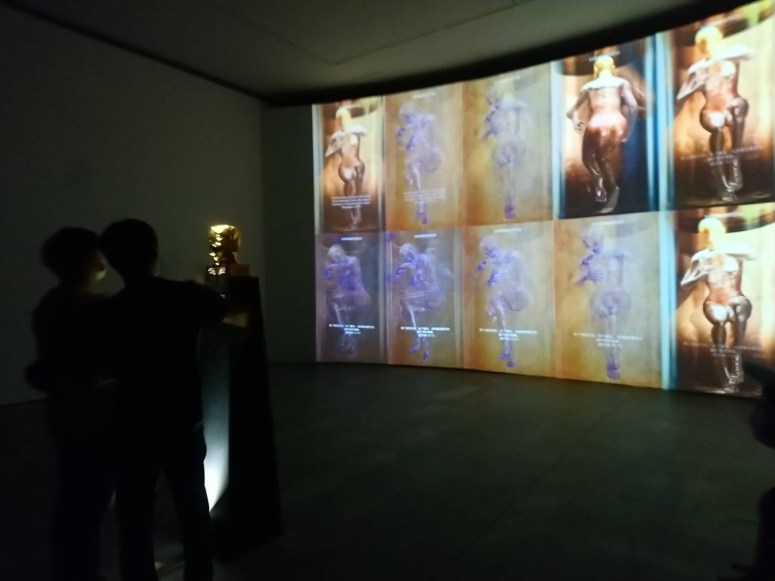
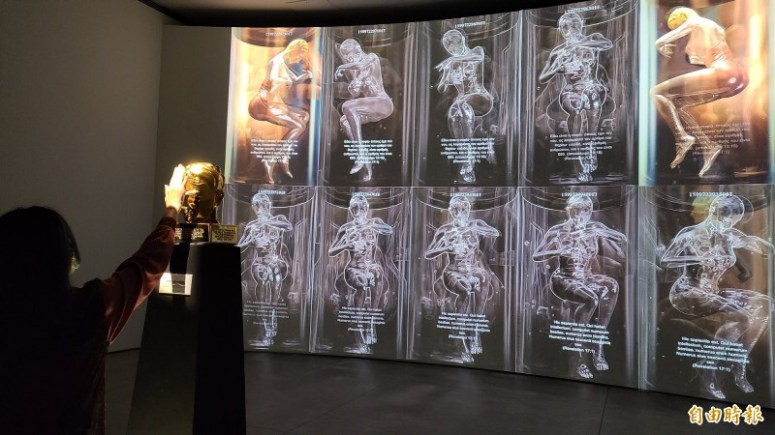
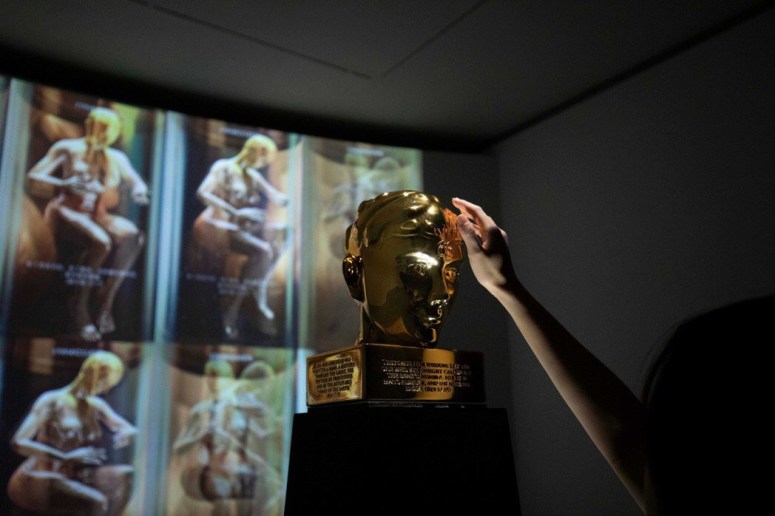
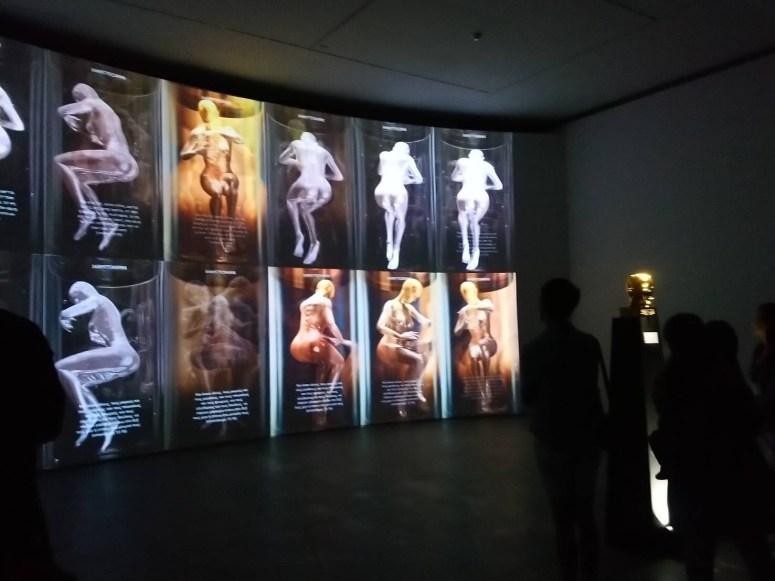
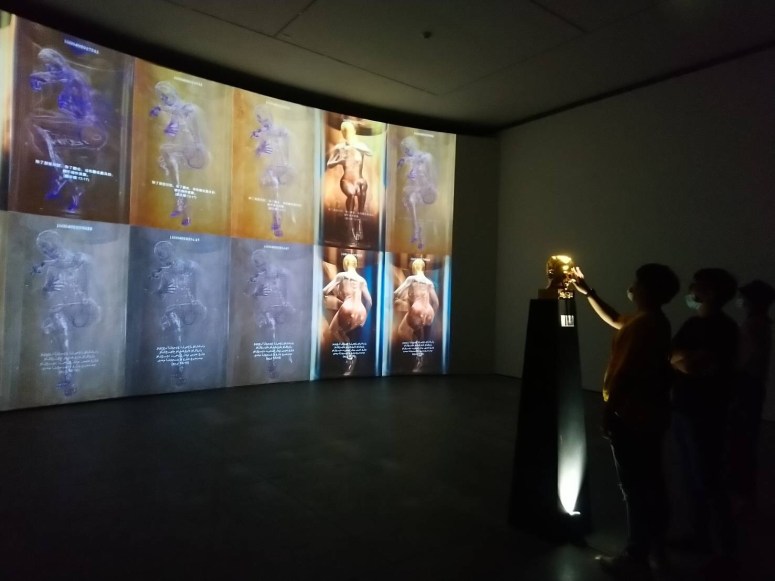
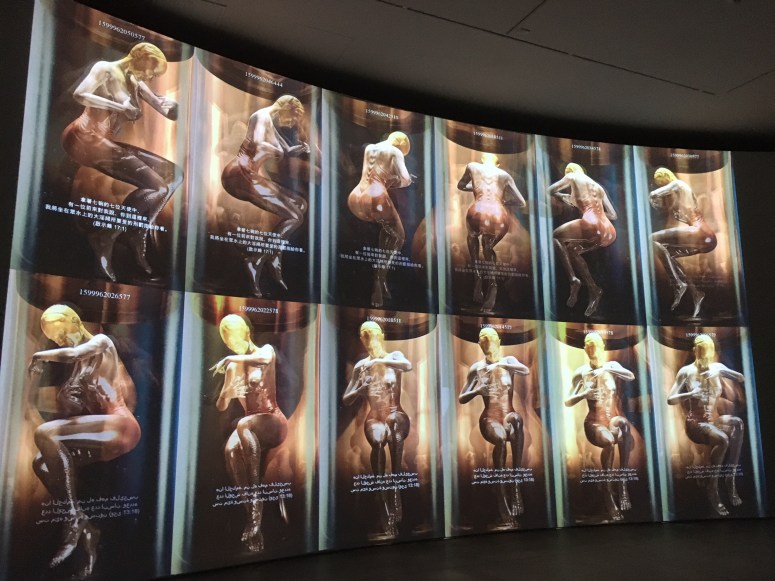
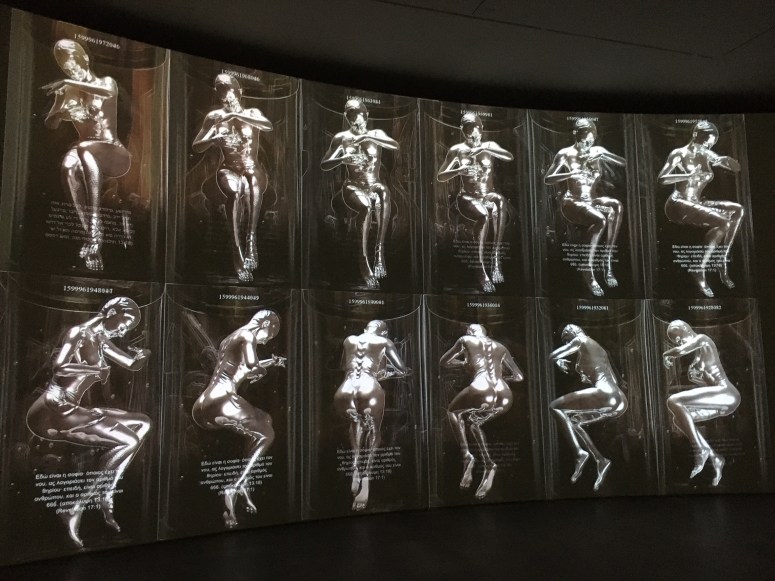
After Pey-Chwen Lin completed the “Making of Eve Clone I”, she created an interactive installation, the “Great Image of Eve Clone”, to further explore the relationship between humans and Eve Clone — the way a human gave life to Eve Clone is similar to how humans have created artificial intelligence or artificial life technologies. Numerous Eve Clone bodies are arranged in curved projections. The bodies, beginning with sketches, computer grids, and metallic-colored skin, then gradually transform into the “Great Image” from The Book of Daniel in the Bible, with a golden head, a silver body, a bronze belly, iron legs, and feet that are partly made of iron and partly of clay. Each body is curled up like a fetus with a bowed head, rotating through 360 degrees during its cultivation and gestation. When there is no audience on site, the images of Eve Clone appear in grey tones and are static, but once the audience members begin to enter the exhibition room, Eve Clone gradually becomes colorful and rotates slowly, which connotes how humans give life to Eve Clone. Above the head of Eve Clone are time codes, which are rapidly changing numbers that signify how time and human beings co-exist in the same time and space. Each Eve Clone image, with its time code, self-replicates at a 3-second interval using delay programming. In addition, selected verses in different languages from the Book of Daniel and the Book of Revelation appear randomly on the soles of its feet, reinforcing Eve Clone’s identity and destiny. To highlight how humans pursue and worship technology, the artist has intentionally created a golden Eve Clone head with 3D-printing. When viewers touch 666, the Number of the Beast, on her forehead, the grand image of Eve Clone transforms into a great image with a moving head and body, showing how she is worshipped by humans. The act of touching also refers to adultery with humans, thus giving her life and making her more lively and more vigorous.




Taoyuan Museum of Fine Arts Collection Highlight
Link:
https://www.facebook.com/share/v/1DbQSKzVyz/?mibextid=wwXIfr
On April 15, the birthday of Leonardo da Vinci, the quintessential polymath of the Renaissance, we commemorate how he used the Vitruvian Man to represent the perfect harmony of reason and proportion, seeking to establish order between humanity and the cosmos through art and mathematics. In contrast, contemporary Taiwanese artist Lin Pey-Chwen reinterprets da Vinci’s classical composition in her interactive digital installation “Great Image of Eve Clone”, transforming it into a complex meditation on technological creation, the female body, and spiritual discourse. The work opens a critical dialogue about the human desire to create.
▌Lin Pey-Chwen, “Great Image of Eve Clone”
Since the 1990s, Lin Pey-Chwen has centered her artistic practice on feminist themes, examining women’s social conditions and structural oppression within patriarchal cultures. Beginning in 2006, her Eve Clone series has evolved beyond feminist concerns, incorporating her devout Christian faith and the visual language of contemporary digital technology to construct an ongoing myth of technological divinity through video and installation.
“Great Image of Eve Clone” is a key work in this series. This interactive installation explores ethical and existential questions surrounding humanity’s use of technology to interfere with life creation. The Eve Clone figure is presented in a visual sequence — from sketch, to digital wireframe, to metallic skin, and finally a fully formed body — displayed on a curved screen. This digital lifeform, shown in a fetal pose with a bowed head, appears to rotate as if gestating in a womb. When no audience is present, the image remains a static grayscale sketch; when viewers enter the space, the Eve Clone is activated, gradually turning to color and beginning to rotate — symbolizing how the human gaze and participation grant it life and reflect the power dynamics between creator and creation.
The work also features a “Time Code” above the Eve Clone’s head — a numerical display visualizing her life status. Through programmed delays and duplication mechanisms, the figure replicates itself every three seconds, demonstrating a form of technological reproduction. This mechanism not only simulates biological reproduction but also reflects the nature of digital image generation and replication in contemporary society.
Additionally, the piece directly incorporates texts from the Books of Daniel and Revelation in the Bible, which appear randomly in various languages beneath the image. These scriptures define the identity and destiny of the Eve Clone, placing her in a liminal space between biblical narrative and technological reality, and addressing humanity’s enduring urge to approach — or even challenge — the Creator through technology.
If a viewer touches the number “666” on the Eve Clone’s forehead, the image instantly transforms into the “Great Image” prophesied in Daniel — with a head of gold, chest of silver, belly of bronze, legs of iron, and feet of mixed iron and clay — symbolizing both humanity’s worship of technological creations and the tensions between human desire and faith.
Through this work, Lin Pey-Chwen engages in a layered dialectic across gender, faith, and technology: from the golden ratio of the Vitruvian Man to the digital fetus of the Eve Clone. The artist not only responds to contemporary reimaginings of creation myths but also reveals — through audience interaction — how humans play the roles of creator, believer, and even the created and replicated within the landscape of advancing technology.
 Lin, Pey-Chwen